Classic Pond Yachts
This is an EBAY purchase a couple on months ago, the boat is being looked after by the very kind old owner, just outside Kings Lyn. Just the pictures for now, I have not yet seen the boat! Pretty sure she is a Daniels Pocahontas from the 1930s ????
10 April 21 --- She is here !!, see bottom of page --


10 April 21 - I picked her up yesterday from a friends place, she was delivered there as one of two boats we had collected to get them home. I must thank Graham who sold me the boat for looking after her for so long, and letting me know when she had been picked up, a good chap!! So she arrived and we removed the sails and had a look, the sails were very well made, the fittings on the boat are all good quality, it is tempting to think it was the hand of Bill Daniels, sadly the truth is we will never really know, but she was built to an extremely high standard. She is missing the top suit mainsail, but has a B and C main, A, B, and C jibs each with their own boom, and a spinnaker with a pole, some pictures below.


I always think the quality of the interior of a model is a good indication of the quality of the build. The condition of the external varnish, fittings the paint etc. indicate that she is old, I see no reason not to believe she was built at around the time she was designed in the 1930s, yet these interior pictures show a model that looks like it could have been built a few years ago, the way the the deck shelf has been carved into the hull to take the deck is really well done, again it shows the quality of the build.


Veiw looking aft, here you can see the splits in the deck, the inside just needs a clean up.
A picture of the deck, it looks like the deck varnish has been sanded back around the fittings, the varnish left is very old and crackled, but the deck looks to be in very good condition, there is a split in the deck aft, but that can be repaired, the difficulty is doing something that when done leaves the inside looking as good as it does now.


Everything about this boat says 'quality' the deck hatch is beautiful, it must have looked fantastic when new. I think it has been made from some of the deck timber, masked up and stained with Mahogany, then lined and varnished, it has a cork bung fitted, finished with a lovely hatch coaming.


Like the rest of the boat, she has really good quality deck fittings, the blocks seem to be mounted onto screw eyes, fitted through washers to protect the deck, then she has a sort of shroud fitted, presumably to stop lines from being snagged?
Pretty transom, you can see the deck where it is sitting on the top of the hull, I can't get any movement by pressing on the deck so it seems well fixed, also the inside pictures show no movement, but it does need some attantion.


There is some history here, you can see where the deck slide has been removed, the cut out for the mast adjustment has been filled with matching timber, and the deck plate has been fixed in place, the mast rake looks about right, but no adjustment can now be made. I think I will make a longer mast slide, fit it to allow adjustment, and to hide the repair. Again you can see blocks fitted with shrouds, for Jib steering control to the Brain quadrant.

This is the biggest jib, with the bigger of the two mainsails The B rig main ?, the quality of the sails is stunning, the hem in the leech of the sails is only 3mm wide, the battens are all made out of timber, she has a jack line along the boom and both the mainsails have hooks on the foot, as well as the luff, this again is an indication that she was built between the wars??


Number 1 jib detail, the panels have been made by lines of stitching on the sail, sounds easy !!! you can see shackles fitted to the jib track for the three rigs, and the hook linkage from the jib ferrule. When reading Bill Daniels book 'Model Sailing Craft' he mentions that there was a tendency to move the position of the jib boom fitting aft to make the leech stand better, but when overdone it kills the boat as the jib leech is then to tight, so the fittings moved forward again. I find it hard to understand why the idea of a jib boom topping lift (now universal) was not used back then ??, they were certainly aware of the cause and effect of moving the swivel aft.


Going down through the rigs, pictures of the A rig jib, with C mainsail, then the B rig Jib and C mainsail, also a picture of the B jib boom, all the booms are calibrated, and very neat !! The jib boom now on the B rig shackle on the jib track.


C rig, the jib is now on the aft shackle on the jib track, again the jib boom calibrated. Another indication of the age, is that if any of the running rigging had any load on it at all, it just broke, all the lines have perished.
And there is a spinnaker!!!!!!


I am really keen to get started on this boat, but I have got to knuckle down and finish Cymbeline to make some room in the garage, and finish decorating the bedrooms!!!!
27 June 2026
So I have got 'Pocahontas' of the shelf where she has been looking great, but she needs work. My intention is to use as much of the original boat as possible, there are some splits in the deck, but I will try to just glue in new timber and clean up the deck, I will get started.

The first job is to remove the deck gear, it can be seen on this picture where the deck has been attacked in places, and looks bad, if she had been allowed to just get old and age, maybe I would have just tidied her up, but she looks poor. The deck gear is interesting.
Here is the Braine quadrant, mainsheet horse and the adjuster for the rudder elastic to adjust the tension.


These two blocks are for the main boom control line to the Braine quadrant when sailing down wind. Upwind the rudder was set amidships and the boat sails trimmed so she sailed up wind. Downwind the rudder was allowed to be steered by the main, it is not hard to see how setting up a Braine steered boat is now a bit of a black art. A lot of sailors at the time did not like wind vanes as they thought it was to easy !!!
This picture shows the jib sheet horse, the mast deck fitting and another two turning blocks. the turning blocks are to take control lines from the jib boom to the Braine quadrant, just to show how hard Braine self steering was, sometimes they steered from the jib, like I said a black art. The thing to remember is that the Braine steering gear was what allowed serious yacht racing to start, before the Braine set up model yachts mostly raced up wind on sail trim, they could not really race down wind, George Braine who designed it changed yacht racing.


This fitting is one of the turning block fittings, they are really nice, made up of 4 parts. There is the block, a round plate on the deck, the block has a screw eye fitted to it, the screw eye screws to the deck through a hole in the deck plate. Then a nice fitting is screwed to the deck to stop lines getting caught, the fitting is made for the shrouds to fit on the deck, shown in the the other picture, it is cut in half, a lot of time and thought went into making each one and there are 4 of them.

This is the Deck fitting cut in half for use on turning blocks.

Before and after. This deck fitting must have been easily available back in the day, I have several of them form other old Models, no idea who made them??


Turning block being taken apart, note broken screw eye in deck !

Another deck fitting often seen, these are sheeting eyes, the sheet can be pulled under the hook, handy to for spinnaker.

Jib rack with three shackles for A, B and C rigs. All deck gear now removed ready for next job.


One of the things that is a problem is there is a crack between the hull and deck most of the way around the deck, here you can see how a knife can be pushed through, I am hoping this is good new, it may/should be easy to remove the deck ?

The cracks in the deck also need sorting, the deck needs cleaning up to see the best way to repair.

I mentioned at the start of this page about the mod to the deck where the mast has been moved forward and the original slide place has been removed and a fixed one fitted. Since buying this boat I have been racing my Stan Witty Wasp Marblehead, I have moved the mast forward on Wasp to stop the boat luffing up on the wind, I have also now fitted a similar system to Pocahontas, the mast slide fitting let in a lot of water, know I am happy with the mast position on Wasp I have fitted a fixed mast plate to stop so much water getting into the boat, may be that is what has happened here??

One thing that has come to light removing the deck gear is that the deck was originally lined, you can see under the mast plate how she was at some point. I will be lining the deck, I am hoping it will help to hide and deck repairs.


As I am going to remove the deck, the timber capping rails and trim are going to have to come off, here I am removing the brass screws.


After removing all the screws the capping rails, and the bow and stern timbers came off easily, no damage etc. I will be able to clean them up, sand and varnish them, ready to refit.


Pictures of the deck with timbers removed, and a picture of timbers laid out on workshop floor, ready to be stripped and sanded.

Next job to remove the deck, hopefully tomorrow.
I started using my Stanley knife to work open the hull to deck joint, As I worked along I used the knife to pull out the brass nails. The glue had failed and the deck lifted easily.


I pulled the vails out with a pair of pliers, all the glue had failed, the deck came off fairly easily with no damage.

Deck lifted, the condition inside is fantastic, beautifully built and still in great condition. I am pretty certain this is the first time the deck has been removed since she was built. The design goes back to the 1930s so I guess she could easily have been built between the wars, possibly 1930s ? Unlikely to have been built after as the design was old by then, nothing happened after the war until the late 1940s.


With the deck removed we can see how well the bull has been built. She has been carved out of as solid block of timber, the quality is remarkable, she is beautifully carved, and then sanded back inside and out. The inside of the hull is very fair. The deck beam is part of the original timber, the hull carved into a radius under the deck beam, she was carved by someone who really new what they were doing.


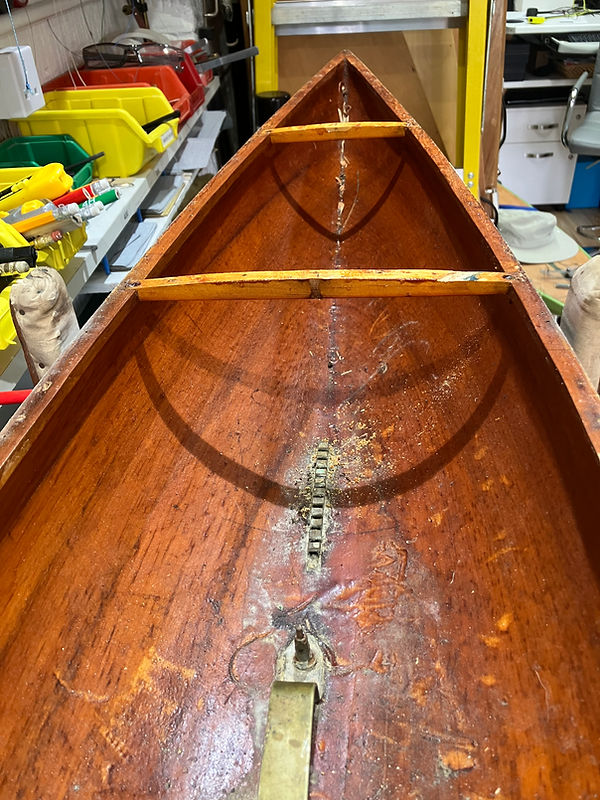

The inside of the hull is not cleaned up yet, but she still look great, deck beams still well fixed, rudder post secure, whoever built her knew what he was doing !! It would be nice to think it was the designer !!!

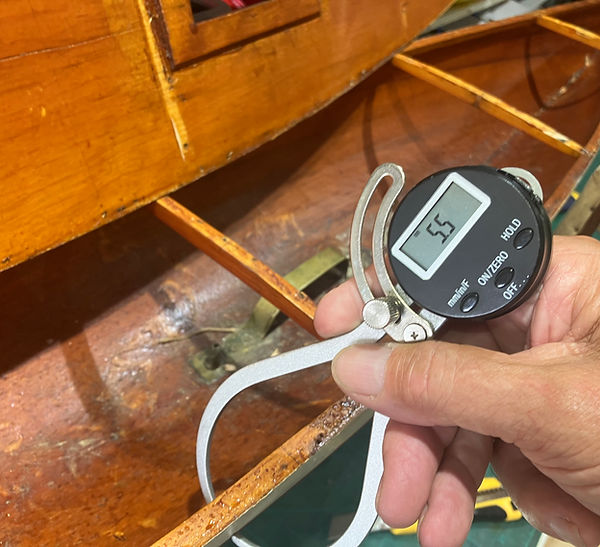

The last few pictures show the hull thickness, the gauge is set in MM and most of the top half of the hull is shown on the display. My measuring tool wont reach the bottom half of the hull, but at its lowest is only around 7mm thick.


I have had a quick go at cleaning up the deck, it looks like a stain has been put on, which is making it hard to clean up.

I Have given the a section on the bow a go with a chisel, cabinet scraper and a final sand, it is not cleaning what ever in on the ply. Also looks like there was a king plank painted in, as we have seen under the mast step, but the dark stain is outside of it ? More work on cleaning to find out.


These keel bolts are very interesting, they are in fact wheel spoke screws, maybe motorcycle wheels?, they are the fittings that were used to tension the spokes, and true up the wheels. Bill Daniels was known for using them for keel bolts, interesting !!!
Got to go to work tomorrow, well some call it work, mostly talk, answer phone and eat sandwiches, someone has to do it !!!
Classic Pond Yachts